Continuing Education Classes

We specialize in high-quality, NCBTMB approved, small-group CE courses designed to offer focused attention, meaningful hands-on learning, and thoughtful discussion. The goal is to provide education that is not only technically sound, but also enriching—courses that help you refine your skills, deepen your understanding, and return to your work feeling confident, inspired, and supported.
Whether you’re looking to sharpen specific techniques, expand your clinical thinking, or reconnect with why you love this work, our classes are designed with intention, care, and respect for the art and science of massage therapy.
Thank you for being part of this learning community. We look forward to learning and growing together.
Kindly,
Angie Wrightstone

Structural Integration
for the Back & Neck
NCBTMB Approved Course
8 CEs
Structural Integration (SI)—often associated with Ida Rolf and sometimes called Rolfing®
Structural Integration—is a form of bodywork that aims to realign and balance the body by working with the fascia (the connective tissue that surrounds muscles and organs).
When focused on the back and neck, the work is precise, slow, and intentional—less like a relaxation massage and more like a guided reshaping of tension patterns.
This course focuses on a back-and-neck–centered SI session which will address:
-
Chronic neck stiffness
-
Upper back tightness
-
Forward head posture
-
Rounded shoulders
-
Desk/computer strain
-
Tension headaches (muscular origin)
The goal is not just to “loosen muscles,” but to:
-
Improve alignment of the head over the spine
-
Free restricted fascial layers
-
Restore natural spinal curves
-
Improve ease of movement and breathing

Structural Integration
for the Shoulders
NCBTMB Approved Course
8 CEs
Structural Integration (SI)—often associated with Ida Rolf and sometimes called Rolfing®
Structural Integration—is a form of bodywork that aims to realign and balance the body by working with the fascia (the connective tissue that surrounds muscles and organs).
When focused on the back and neck, the work is precise, slow, and intentional—less like a relaxation massage and more like a guided reshaping of tension patterns.
The aim in this shoulder focused course is alignment, mobility, and balanced tension, not just temporary relief. The focus is on coordinated movement of the scapula, clavicle, upper ribs, the neck and arms
SI work addresses:
-
Rounded shoulders
-
Forward head posture
-
Shoulder impingement patterns
-
Chronic upper trap tightness
-
Limited overhead movement
-
Tension from stress or desk work

Structural Integration for the Hips, Pelvis, Low Back
NCBTMB Approved Course
8 CEs
Structural Integration (SI)—developed by Ida Rolf—approaches the hips, pelvis, and low back as the core support center of the body. Rather than treating pain locally, it works with the fascia that organizes how the pelvis balances over the legs and how the spine stacks above it.
This region is central to posture, walking mechanics, and load transfer. When it’s restricted or misaligned, discomfort often shows up in the low back, sacrum, groin, or even knees.
Structural Integration in this area addresses:
-
Chronic low back tightness
-
Anterior pelvic tilt or tucked pelvis
-
Hip stiffness or limited rotation
-
Sacroiliac (SI joint) strain patterns
-
Uneven weight bearing
-
Gluteal inhibition
-
Core instability patterns

Structural Integration for the Lower Limb
NCBTMB Approved Course
8 CEs
Structural Integration (SI), developed by Ida Rolf, views the legs and feet as the foundation of the entire body. If the base is imbalanced, that pattern travels upward—affecting the knees, hips, pelvis, and even the spine.
Rather than simply easing tight calves or sore arches, SI works to reorganize how weight transfers through the feet, ankles, and legs in standing and walking.
The goal is improved ground support and efficient movement.
-
Flat or rigid feet
-
Ankle stiffness
-
Plantar fasciitis patterns
-
Shin splints
-
Chronic calf tightness
-
Knee tracking issues
-
Uneven weight bearing
-
Running or athletic strain

Kinesiology Taping for the Upper Body & Lower Body
NCBTMB Approved Course
8 CEs each or 16 CEs earned if taking both classes
This course explores and demonstrates the benefits of kinesiology tape combined with massage therapy on structures of the body.
Participants will learn about the different brands of tape and how to apply it for a variety of purposes; tissue dysfunction, muscle injury/recovery, influence the lymphatic system, postural awareness, and nervous system disorders.
Many clients report feeling like a massage stroke is still happening on the body even after the session is over. The perception of pain can be diminished, as tape can interrupt the pain cycle.
Participants will have ample time to learn how to cut and apply tape, practice taping techniques, experience how tape feels, and how to use it in an everyday practice to enhance the results of the massage therapy session.

Fascial Cupping Release Therapy
NCBTMB Approved Course
8 CEs
Cupping plus active range of motion is a manual treatment that combines negative-pressure cupping over the skin and underlying fascia with guided, patient-active movements to restore mobility, reduce myofascial restrictions, and improve tissue hydration and circulation.
What it is: Cupping creates suction (silicone or plastic cups) on the skin to lift and mobilize the superficial fascia and soft tissues allowing for more blood flow.
While cups are applied, the client performs specific active range-of-motion (AROM) or functional movements to actively stretch, glide, and reorganize fascial layers and improve neuromuscular control.
The therapist sequences cup placement and movement patterns to target lines of tension and movement dysfunction rather than isolated muscles alone.

American Red Cross
Adult First Aid/CPR/AED
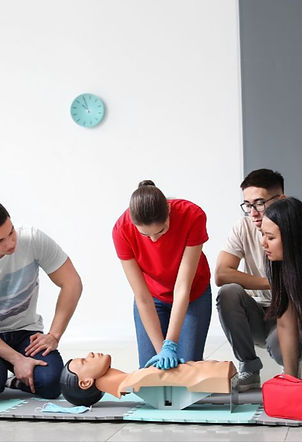
The American Red Cross Adult First Aid/CPR/AED Blended Learning Course teaches participants how to recognize and respond to first aid, breathing, and cardiac emergencies involving adults.
The course combines online learning with an in-person skills session and meets OSHA and other regulatory requirements. Upon successful completion, participants earn a 2-year nationally recognized digital certification accepted across healthcare, education, public safety, childcare, construction, and many other fields.